Menu Our services in the selected location:
  • No services available for your region.
Select Location:
Remember my selection
Your browser is out of date.
GSAM Connect 
|
January 19, 2016

GSAM Connect | January 19, 2016

Developed Market Equities: a New Leadership?

Today, following a multiyear period of outperformance by US equities, we believe investors may be witnessing the early stages of a reversal in market leadership. In particular, we expect stock selection opportunities in Europe and Japan to stand out – and we believe that developed equities outside the United States more broadly may present attractive investment opportunities.

We see upside potential in European and Japanese equity markets for three primary reasons: Changing market leadership, the Eurozone recovery, and the Japanese corporate governance revolution. Below we examine each in more detail.  

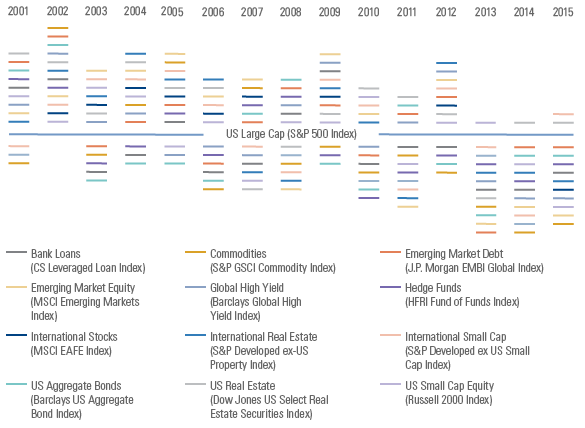
EXHIBIT 1: S&P 500 OUTPERFORMANCE VERSUS OTHER ASSET CLASSES: HISTORICALLY UNUSUAL

Exhibit_1_developed_market_equities.png

Sources: Bloomberg, Barclays, and GSAM. AS of November 30, 2015. All data represent total returns. Past performance does not guarantee future results, which may vary. Please see end disclosures for index definitions.


Changing Market Leadership

As Exhibit 1 shows, the recent run of outperformance by US equities was historically unusual. Today, macroeconomic conditions may be reversing in ways which favor other developed markets. Prominent among these reversals is monetary policy divergence. The Federal Reserve (Fed) is tightening interest rate policy, but central banks in Europe and Japan are maintaining a loose stance – which we see creating a macro tailwind for developed international stocks.

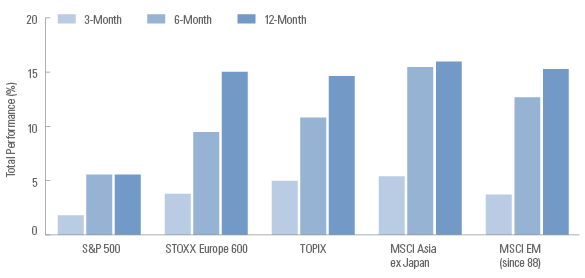
In the past, as Exhibit 2 shows, US interest rate tightening cycles have been a catalyst for equity performance both in the US and globally, but particularly for European and Japanese markets.

Next we’ll turn to what we view as encouraging domestic economic trends in Europe and Japan.

EXHIBIT 2: HISTORICALLY, FED LIFT-OFFS HAVE LIFTED DEVELOPED EX-US EQUITIES

Exhibit_2_developed_market_equities.png

Chart Source: Bloomberg and GSAM, as of November 2015. Performance analysis based on nine historical US rate hikes since 1976, except for the MSCI Asia Ex-Japan Index, which captures four US rate hikes (maximum available data). Please see end disclosures for definitions. Past performance does not guarantee future results, which may vary.


The Eurozone Economic Expansion: Early and Accelerating

Economic growth in Europe today is accelerating, and in early stages. For instance, capital expenditures (capex) as a share of gross domestic product (GDP) are still at a trough in the Eurozone, unlike the US, where the capex versus GDP has risen above the long-term average.1

At the same time, consensus forecasts for gross domestic product growth have been upgraded across key Eurozone countries. This creates what we view as significant catch-up potential for European economies if, as we believe to be the case, the global economic recovery is likely to last several more years beyond 2016.

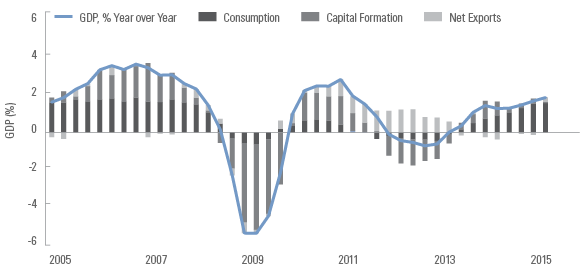
The European economic recovery is already being driven by the strengthening domestic economy to a greater degree than in recent years, as Exhibit 3 shows. In particular, final consumption has been on the rise, counteracting flat or negative contributions from other sources. In our view, however, selectivity is key in seeking to identify the beneficiaries, given that about half of European companies’ revenues derive outside of Europe.2

EXHIBIT 3: THE EUROZONE RECOVERY IS NOW BEING DRIVEN BY DOMESTIC DEMAND

Exhibit_3_developed_market_equities.png

Chart data from 2006 Q1–2015 Q2 reflecting official Eurozone sources. GDP is calculated by the sum of expenditures, namely final consumption, gross capital formation and net exports. Please see additional disclosures.


Japan On The Rise: Corporate Earnings, Profitability and Reforms

A corporate governance revolution is underway today in Japan. Thanks to Prime Minister Abe’s “third arrow” – the push for structural and corporate reforms – there is an intense focus in Japan on shareholder returns for the first time in recent memory.

This governance revolution includes the rise of more independent corporate directors, fewer “cross shareholdings” among business partners (which tend to reinforce control and status-quo policies), and a significant rise in share buybacks and dividends, all of which historically have helped increase return on equity (ROE).

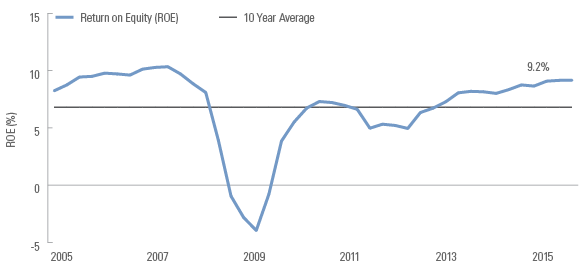
Investors may not realize that Japan is already in line with global competitors by some important profitability measures. For instance, companies are on track to hit double-digit ROEs for the first time in a decade. Projected earnings growth for FY 2016 (ending March 2017) is 17%, higher than Europe.3 As shown in Exhibit 4, Japanese companies’ return on equity is approaching double digits. We believe equity valuations could soon follow.

EXHIBIT 4: JAPANESE RETURN ON EQUITY (ROE) IS APPROACHING DOUBLE DIGITS

Exhibit_4_developed_market_equities.png

Source: Bloomberg and Goldman Sachs Global Investment Research. Shown for illustrative purposes only. Past performance does not guarantee future results, which may vary.


The result, in our view, is fertile territory for security selection, one which offers attractive relative valuations. The TOPIX index is trading at roughly 14.5 times earnings on a 12-month forward basis, below the 10-year historical average of 15.7, and also below historical averages versus the S&P 500 Index and the Stoxx 600.4

In addition, we see an array of positive domestic and macroeconomic trends in Japan. For instance, in a contrast to decades of deflation and anemic growth, Japan’s gross domestic product (GDP) growth (though still among the lowest in developed markets) is now positive and relatively stable. We expect GDP to expand by 1.1% in 2016.5

The weak Yen is one of the more significant macro trends boosting the Japanese economy. The Yen has fallen by nearly 60% versus the US Dollar since September 2012, a significant tailwind for corporate earnings. TOPIX companies derive almost 30% of their historical revenues from overseas.6

Equity market flows have turned positive, underscored by changing pension fund allocations. Japan’s Government Pension Investment Fund (GPIF), the world’s largest pension fund, has increased in its domestic equity allocation to more than 23% (as of mid-2015), with a target allocation of 25%, versus about 17% in mid-2014. Three other government pension funds have followed and we believe corporate pension plans may be next.

Conclusion

We believe that today’s equity market environment opens a number of potential opportunities for developed equity markets outside the US. We see European and Japanese equity markets as attractive ground for security selection for the following reasons:

  1. Changing Market Leadership and Policy Divergence: Particularly with the Federal Reserve tightening but central banks in Europe and Japan maintaining a loose stance, we expect a macro tailwind for developed ex-US stocks
  2. Eurozone Recovery: The European domestic economic recovery is in an early stage and accelerating, creating significant catch-up potential relative to the US
  3. Japanese Corporate Governance Revolution: In Japan, significant ongoing corporate reforms are helping drive accelerated profitability and creating new levels of investment opportunity. Macro improvements, equity market inflows and a series of encouraging domestic economic trends are also positives
Stay posted on the latest market developments and key themes for your portfolios and practices.
Get Connected

Related Posts

January 04, 2016 | GSAM Connect
Adapting to a World of Modest Index Returns

Why we think investors may have to work harder for returns during 2016. 

October 30, 2015 | GSAM Connect
How Smaller Stocks May Offer Larger Returns – Globally

Several global macroeconomic trends have combined to create what we view as an investment opportunity in small cap equities, both in the U.S. and in other developed economies.

September 18, 2015 | GSAM Connect
Three Reasons to Consider Global Bonds Now

Having a purely domestic bond exposure may have served investors well in the past, but we believe a changing fixed-income landscape creates a new logic to consider international bonds.