This is the first in GSAM’s new ETF Spotlight series, which features commentary on topics of interest for exchange-traded fund investors.
In The Spotlight
Stay on top of the latest market developments, key themes, and investment ideas affecting your portfolio and practices.
Explore how we can help you
Talk to UsNote: Separate multiple email address with a comma or semicolon.
Your Name:
Your Email Address:
This is the first in GSAM’s new ETF Spotlight series, which features commentary on topics of interest for exchange-traded fund investors.
Smart beta investment strategies attempt to combine the popular features of market-weight indexing -- low costs, rules-based methodologies, and so forth -- with investment techniques that go beyond market-weight investing. The goal generally is to outperform a market index and/or reduce risk versus the index, by pursuing any of a range of attractive and well-established investment characteristics.
Some in the industry argue that certain smart beta strategies suffer from crowding and high valuations. Others ask whether the typical smart beta strategy improves upon market-weight investing at all. In our view, investors who tap into a range of strategy types can sidestep some of these issues and avoid over-emphasis on any single smart beta approach.
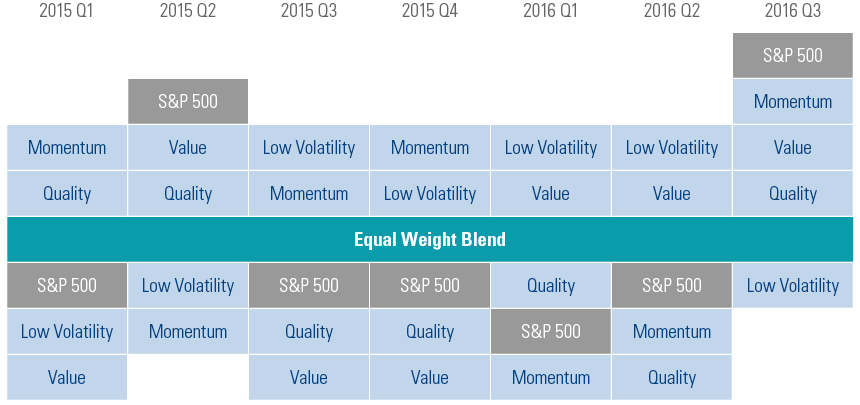
Equal Weight Blend is represented by combining four equal 25% allocations to Momentum, Quality, Low Volatility, and Value. Stacked index rankings are based on returns beginning from the earliest common quarter. The ordering of asset classes represents the relative performance ranking for each index. Momentum is represented by the S&P 500 Momentum Index, Quality is represented by the S&P 500 Quality Index, Low Volatility is represented by the S&P 500 Low Volatility Index, and Value is represented by the S&P 500 Value Index. These illustrative results are being shown for informational purposes only. No representation is made that an investor will achieve results similar to those shown. Indices are unmanaged. Index figures reflect reinvestment of all income or dividends, as applicable, but do not deduct any fees or expenses which would reduce returns. Investors cannot invest directly in indices. The performance results are based on historical performance of the indices used. The result will vary based on market conditions and your allocation. Please see additional disclosures. Past performance does not guarantee future results, which may vary. Diversification does not protect an investor from market risk and does not ensure a profit.
A diversified approach can help investors tap a range of drivers of investment return while also potentially reducing the relative highs and lows of any single smart beta strategy versus a market index.
To test these views out, we examined how a diversified approach has played out recently. In Exhibit 1, we present Standard & Poor’s index returns for four widely followed smart beta investment characteristics: Momentum, Low Volatility, Quality, and Value (see endnotes for definitions and chart notes for index definitions), plus an equally apportioned blend of all four approaches.
The result: The equal-weight blend outperformed the S&P 500 Index the majority of the time, while also avoiding the relative highs and lows of individual smart beta approaches. This is consistent with our expectation that a blend of strategies may deliver a more consistent investment experience, at least in a relative sense versus market indices and versus a narrower smart beta exposure.

Global Head, Strategic Advisory Solutions,
Goldman Sachs Asset Management