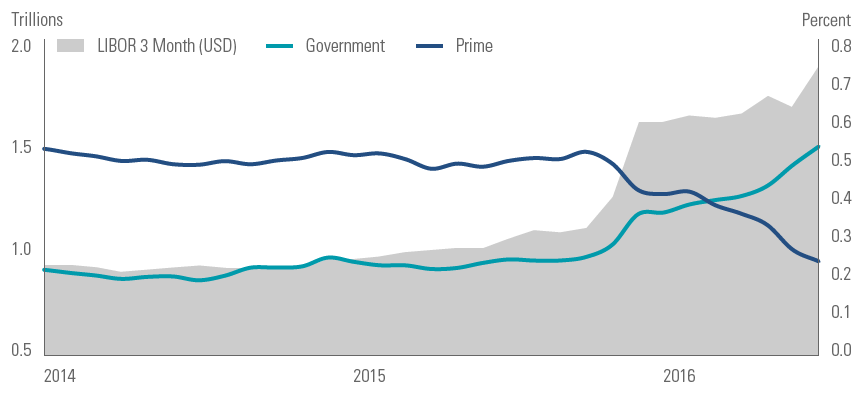
A liquidity rethink may point to different strategies. In the past, liquidity needs may have been met with a limited number of strategies. For at least some investors, this will no longer be the case. Prime funds – to take one example – are fundamentally transformed by the rule changes. We see prime funds today as serving more of an “on demand” function, meaning frequent but less-than-daily usage, instead of the everyday liquidity vehicle they may have represented in the past. Today, considering a broader range of strategies may lead investors to consider options such as short-duration exchange-traded funds or conservative income strategies – two examples of liquidity tools which we think investors should understand more fully.
In prime funds, less may be more. As prime funds introduce floating NAVs and in some cases multiple NAVs, we think a focus on simplicity can help investors adapt. We believe investors may gravitate toward prime funds offering a single daily NAV, since the simplicity of this approach allows investors to focus on core features such as same-day liquidity and incremental return. Thinking about liquidity needs across a few different usage categories also may help. Two such categories are daily liquidity – that is, meeting everyday cash needs -- and the above-mentioned on-demand liquidity, where usage may be frequent but less frequent than daily.
Not all government money market funds are the same. Contrary to their reputation, government money market funds (which invest primarily in cash, government securities and/or repurchase agreements) can offer a range of risks and returns. In the past, the differences between funds have often been obscured by low interest rates. We think the differences will be more noticeable if interest rate volatility increases or interest rates rise. As an example, during both the October 2015 debt ceiling debates and the Federal Reserve’s December 2015 interest rate hike, funds which seemed alike on the surface delivered different risk and return characteristics1. This is why we believe active management matters even in ostensibly similar government money market funds.
Money markets time and again have adapted to new market environments, regulations, and fund features. This time, too, we believe the industry and investors will adapt – and we think the time to adapt is now.