

Menu Our services in the selected location:
  • No services available for your region.
Select Location:
Remember my selection
Your browser is out of date.

Q1 2016 | Global Fixed Income Outlook

Markets Brace for Bear Case

EMAIL THIS

Note: Separate multiple email address with a comma or semicolon.

SEND
Send me a copy

EMAIL THIS

Note: Separate multiple email address with a comma or semicolon.

Your Name:

Your Email Address:

OPEN EMAIL TO SEND
Send me a copy

The new year opens on a significant shift in the global macro backdrop, with the US Federal Reserve (Fed) having raised interest rates. However, global monetary policy is likely to remain highly accommodative and we expect the global economy will maintain its course of positive, but sluggish, growth and low inflation.

These are benign—indeed, supportive—conditions for fixed income markets, but valuations in some sectors suggest investors are more focused on potential worst-case scenarios in growth and inflation, commodities and corporate credit, and emerging markets and China. These are grounds for concern and potential drivers of volatility in 2016, as we discuss in the following pages. However, we still see opportunities in select areas and relative value strategies.

  • „„Our global economic outlook is still positive but softer than consensus, as broadly favorable trends in consumer demand and job creation are offset by weak external demand, capital expenditure and wage growth.
  • „„ We believe the Fed is likely to raise interest rates three times in 2016 if inflation picks up as expected. However, we think the Fed could move more slowly—in line with market expectations—if financial conditions tighten too much.
  • „„ On the easing side of policy divergence, we believe quantitative easing (QE) will remain a key policy tool for the European Central Bank (ECB) and Bank of Japan (BoJ) this year, but the limitations and drawbacks of this strategy are increasingly clear.
  • The commodities market downturn doesn’t look likely to let up any time soon. We see potential for additional near-term downward pressure on oil prices due to concerns that storage is getting close to full capacity.
  • „„ We think the credit cycle has further to run but concerns are mounting as it advances into the late stage, and given the risk of contagion from the distressed energy and mining sectors. These concerns are keeping us from being more positive on risk assets, but we remain constructive on corporate credit as we think current valuations reflect an overly pessimistic scenario for the global economy and markets.
  • Turning finally to the predominant market focus, our concerns about China haven’t changed,given the persistent risks of policy missteps, equity and currency market volatility and strong credit growth. The pressures of China’s competing objectives in the transition to a consumer-driven,market economy are evident, but we believe authorities are focused on containment, which may limitrisks to the global economy and markets.
Growth Outlook

Over the coming year, we expect the backdrop of modest-but-positive global growth and supportive policy to remain in place. We think that is good news for most asset classes. However, investors appear less focused on the growth outlook, which we discuss below, and more worried about the potential negatives, including monetary policy uncertainty, weak inflation, the drag of commodity prices in credit markets, and risks in China, as outlined in the sections that follow.

We also sense that markets are increasingly focused on geopolitical intrusions on this benign macro backdrop, such as the threat of terrorist attacks and the displacement of millions of people from Syria and other war-torn regions. We think these developments may have more influence on the political and economic landscape in the years ahead, and we would expect increased volatility if concerns about potential terrorist activity escalate and impact investor sentiment.

  • „„We believe the US economy can sustain a gradual increase in interest rates. US rates are pricing in a shallower trajectory than policymakers suggest but, with the Fed likely on hold until at least March, we think yields may not adjust much higher in the near term. We see the Fed hiking three times in 2016, provided inflation picks up as expected and financial conditions don’t tighten too much. We expect growth to moderate to around 2.2%, as consumption may soften with the fading benefits of low oil prices. The main setbacks are weak external demand and capital expenditure cuts in the commodities sector. Inflation pressures are still modest but should increase as wage growth responds to the tightening labor market.
  • China’s growth continues to slow. Achieving the 2016 target of 6.5% will be challenging and requires further policy support. A weaker renminbi in the context of monetary or fiscal easing will help at the margin, but given policymakers’ preference for gradualism we don’t anticipate a large depreciation. Challenges persist from the housing overhang, oversupply in the industrial sector and unresolved weaknesses in the financial system. Rising consumer spending and relatively healthy services activity are supportive domestic factors, but the risks of spillover from manufacturing weakness can’t be ruled out. We expect further targeted stimulus by the People’s Bank of China (PBoC) and the government, with policymakers continuing to balance reform objectives against the need to generate growth.
  • „„ We think weak Eurozone inflation will lead the ECB to ease again in the second half of 2016, and downward pressure on yields is likely to continue. Our growth forecast for the region is slightly below consensus at 1.4%, due to weak external demand and potential softening in domestic consumption. The refugee crisis could prove more challenging than Greece’s bailout, as the Eurozone still lacks a fiscal framework for cost-sharing, and political and economic strains could further strengthen radical nationalist parties and pose setbacks to austerity. That said, we see a positivecontribution to growth from increased government spending on national security and services to accommodate the expected migrant intake.
  • „„ Japan also faces continued challenges in getting inflation back on target, though the recent firming in the core reading may keep the central bank on hold through 2016. We see Japan’s growth improving to around 1.1% in 2016, with consumption still supported by low oil prices and additional benefits from a tourism boom, but Japan shares the common challenges of weak global demand and capital expenditure.
  • We see UK growth slowing toward trend in the low 2% area, thanks to continued fiscal cutbacks and weak exports. However, UK rates will probably continue to underperform Eurozone markets as the Bank of England (BoE) nears its first rate hike, possibly around mid-2016. Weak inflation could delay a move, since recent data point to an unexpected slowing in wage growth despite the UK’s tight labor market. In our view, the main risk to the UK’s outlook would be a vote to exit the European Union, though we think this outcome is unlikely. We expect the referendum will be held in June 2016, but it could be put off to later.

Monetary Policy Divergence and the Limits of QE

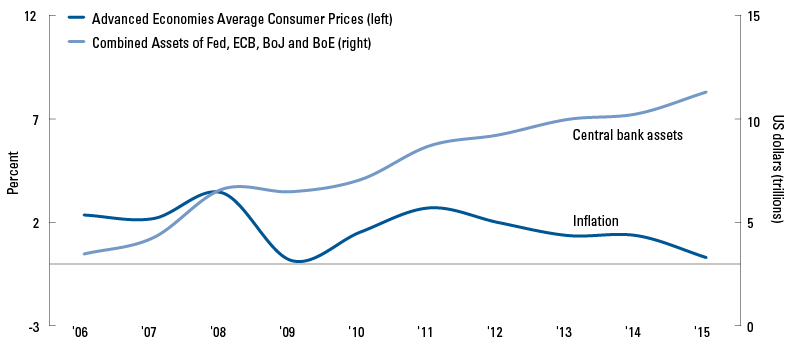
Monetary policy divergence is in full swing, with uncertainty on both sides of the policy divide. The big question of 2015 was the timing of Fed lift-off; now investors worry if the economy can handle the ascent. US rate markets are pricing in a shallower trajectory of hikes than the Fed’s central projections—and ours. As the year progresses, we think the focus may shift to the final frontier of policy outside the US. ‘QE Infinity’ is a troubled mission, as inflation in both the Eurozone and Japan is barely responding to massive central bank balance sheet expansion. We don’t see these programs ending in 2016, but we think opposition is mounting and the search is on for alternatives.

Turning first to the US, we think Fed policy is most likely headed for a low orbit. Our base case is for three hikes in 2016, but the Fed could move even more slowly if inflation disappoints or financial conditions tighten too much. US rate markets are currently priced for this weaker scenario, and we think they may be underestimating the possibility of inflation normalizing sooner than expected (see p.4).

For central banks in full-blown easing mode, we think QE’s status as the dominant nontraditional policy tool is on the decline. Both the ECB and BoJ disappointed markets with mild actions in December, reinforcing our view that open-ended commitments to large-scale asset purchases are getting problematic. The ECB’s German contingent rejected QE expansion favoring more time to assess existing measures. In Japan, yen weakness has hurt purchasing power for households and domestically-oriented businesses, and four of the nine BoJ board members opposed the last expansion. The canary in the QE coalmine could be Sweden’s Riksbank, which has eased heavily to stem the tide of inflows from the euro, despite strengthening growth and
rising house prices. Sweden now boasts the largest QE program as a proportion of total debt stock—around 34% of outstanding government bonds—and we see some market backlash against
the adage ‘don’t fight the central bank.’ In October the krona gained in response to more QE, challenging the Riksbank’s commitment to currency competitiveness, and in December the bank’s pledge to intervene as needed had little impact.

The near-term bar to more QE is high, but policy divergence hasn’t peaked—the ECB and BoJ must still find ways to hit their inflation targets. Given their recent modest actions, we see more
stamina in trades based on the policy contrast between the Eurozone and the US and UK, which is also likely to hike rates in 2016. We think the ECB’s economic forecasts are optimistic and inflation is likely to be revised down in March, bringing further policy easing in the second half of the year. In Japan we think the BoJ will probably remain on hold in 2016 due to recent firming of core inflation, though the level is still well below target. However, any tightening of financial conditions via a stronger yen or weaker domestic equity market will raise the odds of another move.

Inflation remains weak despite massive central bank balance sheet expansion

Source: Bloomberg, IMF, GSAM, as of December 31, 2015


We don’t see central banks scrapping QE in 2016—the shockwaves in domestic markets would be too great—but we do expect more scrutiny and a shift toward alternative measures. The ECB can cut its deposit rate again, but the BoJ’s options may be more limited, shifting the emphasis to fiscal spending and corporate reform. In the meantime we are watching for more volatility related to QE policy as this powerful driver of demand in key high-quality markets falls out of favor.

The Wage-Less Recovery

Positive growth and declining unemployment still haven’t stirred corresponding wage pressures. On the one hand, the lack of wage growth raises concerns about ‘secular stagnation’ and the durability of the recovery, which are reflected in the US market’s very conservative expectations for the path of interest rates this year. On the other hand, if tightening labor markets lead to faster wage growth as traditional economic models suggest, we see potential for upside inflation surprises, lower corporate profitability and tighter central bank policy.

Inflation will probably remain below target in much of the world this year, in our view, but divergent trends in global price pressures have been brewing for some time, and US inflation may rise back toward the 2% target sooner than markets expect. As a result, while we are positioning tactically in the near term, we are cautious on US interest rate risk over the longer term.

In Japan and the UK, promising signals have stalled. Japan’s unemployment rate hit a 20-year low of 3.1% in the fourth quarter, but wage growth is still meager at 0.4% on the year. This is a backslide from the 0.8% base pay increase recorded a year ago, when the Abe government’s increased pressure on corporations to boost compensation appeared to be taking effect. Meanwhile, UK unemployment is close to a decade low at 5.2%, but wage growth slid back to 2% in the three months to October, from 2.4% in the period to September.

In both cases, sluggish wages may be attributable in part to the changing structure of the workforce. In the UK, the growth of low-paid services sector positions relative to high-skilled jobs is
one explanation, along with the rising proportion of migrant workers. In Japan, the rapid growth in part-time employment is a big factor, due partly to companies trying to cut costs further in a weak growth environment, and the latest Tankan survey showed a surprising drop in hiring intentions.

The US shares this dynamic of a tightening labor market and weak income growth, but we think its structural challenges are less pronounced, and a tipping point for wages is approaching. Average hourly earnings are around 2.3%, well below the 3%-4% pace the Fed is looking for. However, the trend is gradually rising, and could accelerate if job growth continues at its robust pace, pushing the labor market to an inflection point. Headline unemployment has declined steadily to just 5%. The broader U6 measure—which includes jobseekers who have had to settle for part-time work and those who haven’t looked in the past few months—is close to 10%, compared with 8% in late-2006. We think this remaining slack could wind up in the next sixto nine months.

The timing and extent of pass-through to prices more broadly are unclear but we think this additional upward pressure could have a significant impact. US core personal consumption expenditure (PCE)—the Fed’s targeted measure—is still well below target around 1.3%, but core consumer price inflation (CPI) is at 2%. Even the depressed headline CPI rate, which includes energy prices, is expected to rise in the coming months as the previous year’s steep decline in oil prices drops out of the annual comparison. We think this combination of factors is likely to push
market expectations for US inflation and rate hikes to adjust higher in the coming quarters. 

The outlier is the Eurozone, where unemployment is improving, but remains in the double-digits, and structural factors such as competitiveness adjustments in the peripheries are additional
constraints on workers’ earnings. These factors underpin our expectation for further ECB easing and continued downward pressure on Eurozone yields.

Commodities Stay Low for Even Longer

Global oversupply continues to exert its gravitational pull in industrial commodities markets. Oil prices remain under pressure due to slower-than-expected declines in US shale production and continued increases in Middle East production. The base metals sector is burdened by concerns about Chinese demand, as long-term mining projects continue to come online. In the near term we still see risks skewed to the downside for prices. While we see adverse knock-on effects for some risk assets—notably the high yield corporate sector (see p.6)—we believe the implications of low commodity prices for the US and other developed economies are still broadly favorable as a support for consumer demand.

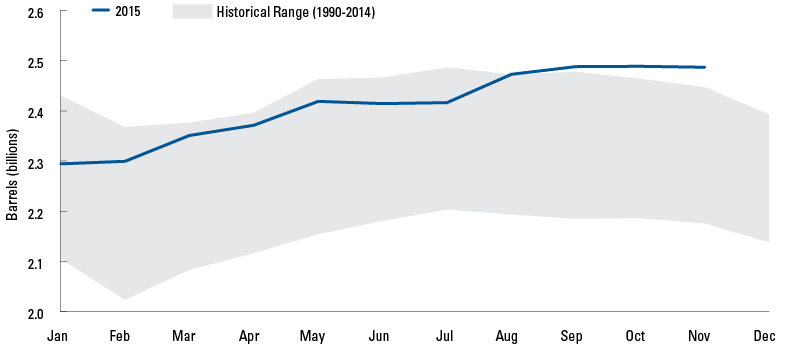
The glut in crude, which dragged prices close to $30 a barrel in the new year, owes in large part to the past decade’s revolution in US shale drilling and the recent ramp up in Middle Eastern production. The sharp fall in oil prices over the last year has led to a decline in US shale production over the last nine months. However, the reductions in shale supply have been slower than anticipated and have helped keep the market in surplus. This continued surplus has allowed global oil inventories to build to record highs, and the risk of storage congestion has increased materially for 2016, assuming prices remain at current levels. We view full storage as more a concept than a reality, as prices in markets approaching full storage should adjust lower, forcing supply down to match demand. Nevertheless, as the risk of congestion increases, so does the likelihood of a further leg down in prices, and this prospect underpins our near-term bearish view on global crude prices.

In industrial metals, the supply/demand imbalance is more directly related to slowing growth in China, which accounts for 40%-50% of global demand for base metals. China’s transition away from an investment- and manufacturing-led growth model to a more consumer-driven market economy is likely to be challenging, and China’s recent stock market volatility underscores this concern. We do not expect supply in base metals to correct that quickly, since market prices for industrial metals are still above cost of production in many cases. We remain cautious on base metals for 2016.

Crude oil and product stocks for US, Europe and Japan have topped their historical range

Source: PIRA, as of November 2015


Commodities and the Credit Cycle

Low commodity prices benefit consumers and should be a positive for growth, but investors appear more focused on the impact that low energy prices are having in the US high yield market and the potential spillover effects on the US credit cycle. We believe the credit cycle has further to go in 2016, though cross-currents warrant a cautious approach with more emphasis on tactical positioning and security selection.

We expect the US high yield default rate to climb to 5%-5.5% in 2016 from 3.2% in 2015, putting defaults above the long-term historical average of 4.7%. The majority of this increase comes from the energy and metals & mining sectors—which together compose around 18% of the total high yield market—due to the cumulative effect of persistently low commodities prices.

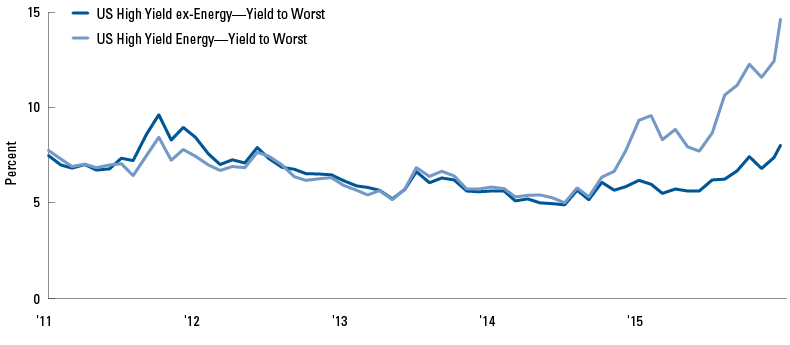
Market pricing suggests as much as half of the US high yield energy sector could default over the next several years. The longer oil prices remain very low, the greater the risk that those energy sector defaults are front-loaded and the greater the risk of spillover into other sectors of the market. We think this dynamic has contributed to concerns about the US credit cycle and associated widening in ex-energy high yield spreads since mid-year 2015 (see chart).

High yield ex-Energy has weakened along with Energy recently

Source: PIRA, as of November 2015


While we see rising risk, we think concerns about the credit cycle are premature. In our view, US growth in the 2%-3% range is the sweet spot for credit—strong enough to provide cash flows that allow corporations to service their debt, but not so strong that management becomes overly exuberant with credit- negative behavior. Thus far companies have been conservative on margins and capital expenditure and are keeping more cash on balance sheets. That said, some typical late cycle signs have become more pronounced, including increased mergers and acquisitions (M&A), leverage and shareholder-friendly activity. M&A has surged amid a lack of topline growth, driving record levels of new investment-grade issuance over the past year and pushing spreads wider. We see continued hurdles to revenue growth, including pricing challenges in a low inflation environment and demand challenges as growth slows in emerging markets. As a result, we expect robust M&A activity to continue in 2016, providing new opportunities to consolidate and cut costs, but wider spreads and higher rates may slow the pace as the year progresses.

We think volatility is likely to pick up as the credit cycle advances and investors demand higher premiums for illiquidity. However, we believe spreads adequately compensate for likely credit losses, and the extent of volatility this year will depend in large part on commodities prices. We believe the market will remain significantly correlated with oil in particular. In our view, stabilization in oil prices, even at current low levels, would calm the market, and a recovery would help sentiment and credit performance. As the cycle matures, we are less likely to hold a strategic long position in credit for an extended period of time. However, we believe the market is still at an early point in the late stage of its cycle. This credit cycle has been elongated and we expect this late stage to last longer than most, presenting opportunities to take advantage of dislocations in spreads and mispricing of assets in 2016.

Cautious Composure on China

Markets will probably continue to focus on China’s slowdown and policy uncertainty as a potential trigger for volatility in 2016. We think these concerns are justified—China seems to have been on the brink since the economy started to slow and our assessment of risks hasn’t changed much. But the pace of growth has more than halved over the past eight years without a full-blown crisis, and we believe a disorderly outcome is a tail risk rather than a central case. Authorities are balancing often- conflicting objectives of supporting growth and social harmony and pursuing reforms as China transitions from an investment-led to a consumer-driven market economy. But we believe they are motivated to limit potential damage to the global economy and markets, and have the resources to do so.

Growth remains a key challenge, and we think China’s 6.5% target for this year is ambitious. Even without the austerity drive related to China’s anti-corruption campaign, the economy is burdened with oversupply in the manufacturing and housing sectors and investment is likely to slow further in the first half of 2016. That said, we see significant dispersion between the troubled industrial sectors and those exposed to consumer spending, new technology and services. Moreover, we believe authorities will find ways to make up any shortfall, as was the case in 2015 when a combination of targeted stimulus and financial and real estate services helped push growth to 7%.

Currency depreciation could also help growth by easing financial conditions, but authorities may be unwilling to weaken the renminbi enough for a significant impact. China’s currency policy is an area of uncertainty that we expect markets to focus on this year, alongside potential equity market interventions. Our base case is for the renminbi to shed around 5% in 2016, and the benefit to China’s exports is probably limited amid widespread currency weakness and soft global demand. A more aggressive devaluation may have a bigger impact on growth, but would likely trigger heavy capital outflows, global political tensions and volatility. This could undermine China’s aim to establish the renminbi as an global reserve currency, having just secured the symbolic status of inclusion in the IMF’s special drawing rights basket.

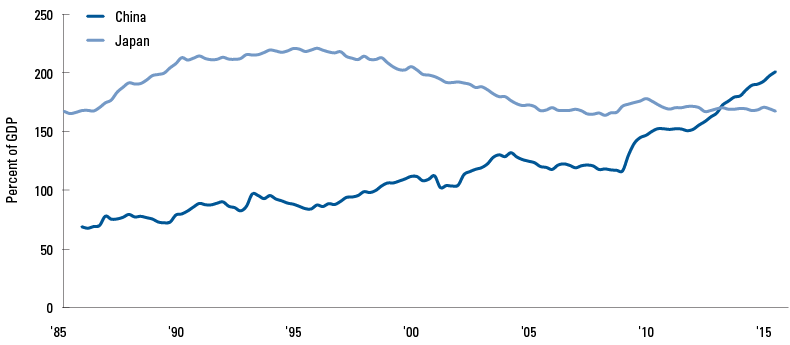
We still consider rapid credit growth one of China’s most pressing problems. The pace has slackened but, at roughly 14% on the year, credit expansion is still twice as fast as economic growth, driving the debt-to-GDP ratio in the non-financial sector above 200%. Moreover, as economic growth slows, we are increasingly concerned about the ability of companies to meet their obligations, and the lack of transparency on the volume of non-performing loans clogging up the financial system. That said, we believe that authorities most likely have the resources to address this problem over the longer term, and the motivation to prevent a systemic event in the interim.

Our cautious composure on the risks surrounding China leaves us less anxious than some on the outlook for emerging markets more broadly. We continue to see headwinds for commodity exporters that were heavily geared to servicing China’s former manufacturing boom. However, we believe this is part of the global challenge of the commodities market downturn. We believe the adjustment to China’s shifting growth model is under way, and new opportunities are emerging for countries that can exploit growing demand for services and consumer goods among China’s evolving middle class.

Credit to the corporate sector continues to surge in China

Source: BIS, UBS, GSAM, as of June 30, 2015


Follow trends in the global economy, including policy issues and analysis of economic development from Goldman Sachs Global Investment Research.
See More

Explore Insights by Topic

More Insights

Q4 2015 | Global Fixed Income Outlook
Holding Pattern
Chinese market turmoil, a Greek fiscal crisis, plunging oil prices, and the prospect of rising interest rates certainly can put investors on guard. But we believe this year’s bouts of volatility are the sort which stir markets without shaking their foundations.

CONTACT US See More

For More Information
Broker/Dealers
Independents/RIAs
Banks
Retirement Services
Client Service
A & C Shares
Institutional Shares