A more protectionist stance among the world’s largest economies will have reverberations, and currency markets are arguably most exposed. We talked to Francesca Fornasari about the team’s outlook for the dollar and across emerging markets.
In The Spotlight
Stay on top of the latest market developments, key themes, and investment ideas affecting your portfolio and practices.
Explore how we can help you
Talk to UsNote: Separate multiple email address with a comma or semicolon.
Your Name:
Your Email Address:
A more protectionist stance among the world’s largest economies will have reverberations, and currency markets are arguably most exposed. We talked to Francesca Fornasari about the team’s outlook for the dollar and across emerging markets.
The dollar has strengthened a decent amount since the US election and we think valuations are extended. However, we are positioned for further moderate gains in the near term against other developed market currencies. We expect a modest bounce as the market adjusts to a faster pace of Fed tightening—our base case is for three interest rate hikes this year, based on fiscal expansion and provided that financial conditions don’t tighten too much. And we see more upside for the dollar in the event of trade disruptions, which could drive safe-haven flows to the US.
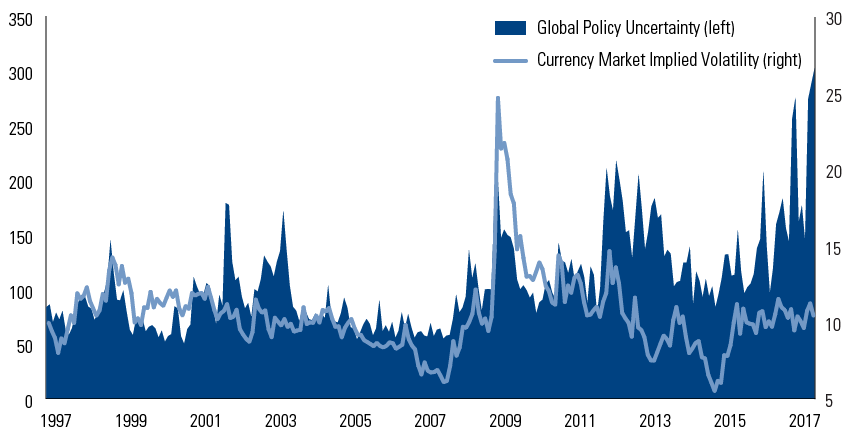
One risk to our view in this uncertain policy environment is the potential for more rhetoric. The president and his trade advisor were recently reported making statements that added Germany and Japan alongside China as targets of criticism for devaluing their currencies, and appeared to support a weaker dollar. We see more volatility and potential downside for the dollar if this rhetoric escalates. And while there are hurdles that could delay or prevent action on the president’s pledge to label China a currency manipulator, such a move could weaken the dollar if Chinese officials don’t retaliate significantly. That said, we believe on balance that the trend toward protectionism is dollar-supportive.
We don’t think the trade policy outlook is reflected in the dollar’s valuation. Markets still reflect a lot of uncertainty over how the new administration will proceed with the agenda outlined in President Trump’s campaign. But we see no reason to discount Trump’s most consistent messaging on trade policy—particularly given his solid progress so far in delivering on his pledges—including a renegotiation of NAFTA and increased use of tariffs.
We anticipate bouts of volatility as these policies evolve, and some have a longer timeline than others. Steps that require congressional approval—such as including a border adjustment provision in reforms to the tax code—may not be actionable this year, given the new administration’s competing priorities and the need to build consensus within Republican ranks.
As we look to the longer term, we think the dollar’s performance will depend on whether US policy turns out to be ‘protectionist-lite’ or a more aggressive version. Our base case is for somewhere in between, as President Trump’s aim to support American manufacturing isn’t necessarily served by policies that make US goods less competitive.
Source: Bloomberg. As of February 6, 2017
We think a border adjustment tax (BAT) would be a game changer for the dollar. Unlike tariffs—and depending on the specifics of the legislation—the BAT could apply to all goods and services, imposing a levy on imports and credits for exports. Some estimates suggest that a 20% BAT could lead to a 20% dollar appreciation.
That said, the BAT’s prospects are cloudy. It has appeal as a revenue raiser, but wasn’t on Trump’s list of action items. The BAT raises three main problems: potential setbacks for companies with global supply chains, the risk of higher import costs driving up consumer prices, and a potential loss of competitiveness for exporters due to dollar strength. Trump has alternatively proposed “massive border taxes,” which we would expect to target US companies shifting production offshore.
The president can make headlines with little overall economic impact if he acts selectively with tariffs. The world of import tariffs is complex enough that it is possible to target goods in sectors or to countries that account for only a small proportion of US trade, by dollar value, percentage of total volumes or percentage of GDP. It is possible that this sort of targeted but high-profile strategy could be the default position for the coming months, as the president has power to act unilaterally on tariffs.
Action of this kind would likely have an idiosyncratic sectoral- or country impact with limited global repercussions—numerous countervailing duty orders have been issued over the past decade without major trading disruptions. For instance, a tariff on steel imports would address a modest portion of the US’s trade deficit with China. By contrast, tariffs on transportation goods from Mexico, or computer components from China would affect much larger channels, with more potential to trigger damaging retaliatory action.
On the frontlines of Trump’s plan to renegotiate NAFTA, Mexico and Canada are most exposed to a broadbased decline in US demand, based on exports to the US as a percentage of local GDP. GIR estimates they could lose 2% of GDP in production for every 1% drop in US imports.
We are positioned for the US dollar to strengthen versus the Canadian dollar, based primarily on Canada’s softer growth outlook and the prospects for a rate cut. We see more upside for the Mexican peso, given the dramatic selloff following the US election, which we think has overstated the likelihood of a trade war in the near term, and understated the prospects for Mexico to benefit from improved US growth.
Broadly speaking we are constructive on emerging market currencies, which we believe are widely undervalued. We see a recovery from the commodities-driven downturn, and we think many developing countries are better placed to withstand dollar strength today than they were five years ago, when valuations were stretched and balance of payments were weaker. However, we are less sanguine on the outlook for smaller export-oriented economies in Asia, which are exposed both to reduced US imports and slowing demand from China.

In Asia, Taiwan and Korea have the largest trade relationships with the US as a proportion of exports to local GDP. They also could suffer from the knock-on effect of reduced exports to China if it retaliates to protect its own domestic market. China’s “backward integration” of electronics production—that is, the trend of manufacturing items it previously imported—has already weighed on trade with its neighbors.
China is the primary target of Trump’s criticisms of unfair trade practices, but its economy is less vulnerable to a deterioration in trade with the US, as they account for just 3% of GDP. While reduced trade with the US poses short-term downside risks to China’s economy, the more significant threat in our view is if Chinese policymakers divert their attention from much-needed reforms in order to stabilize growth. Since their efforts tend to rely on credit expansion, we see a possible acceleration in China’s already excessive credit growth.
The complicated process of the UK’s exit from the EU starts next month and will run for two years, and this is a tight window for renegotiating all the UK’s trade relationships with Europe. We expect increased volatility, and we think the British pound will probably weaken further as uncertainty is likely to weigh on consumption and investment.
We also see further downside for the euro against Nordic currencies, based mainly on their stronger growth outlook, and versus the Swiss franc, due to political uncertainty. We think the upcoming elections will drive volatility in euro area markets, which could persuade the European Central Bank (ECB) to stay on hold or even ease further, which would weigh on the euro.