Menu Our services in the selected location:
  • No services available for your region.
Select Location:
Remember my selection
Your browser is out of date.
GSAM Connect 
|
November 11, 2015

GSAM Connect | November 11, 2015

Do You Know Where Your Risk is?

When building portfolios, many investors start with a set of asset classes –stocks, bonds, and so forth – and apply criteria such as risk tolerance or desired investment returns when choosing which ones to own. In our view, however, many investors fail to take what we view as an important next step: Understanding where a portfolio’s risks and returns come from. We believe the results can be surprising. Portfolio risk – as measured by the annualized volatility1 of past returns – is often concentrated heavily in one part of a portfolio, even though investors generally can reduce such risk concentrations.

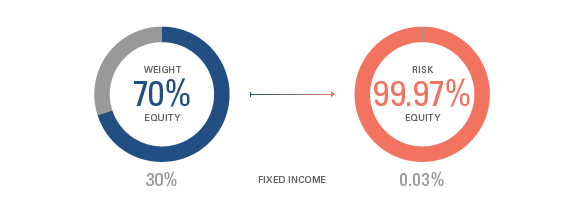
EXHIBIT 1: HISTORICALLY, EQUITY RISK HAS DOMINATED PORTFOLIO RISK IN CERTAIN COMMON INVESTMENT APPROACHES, SUCH AS THIS HYPOTHETICAL PORTFOLIO

Diversifiers Risk Allocation chart 1

Source: GSAM, Bloomberg. For illustrative purposes only. The 99% equity risk measurement is calculated as a proportion of total portfolio volatility, as measured by the aggregate monthly price moves of the asset classes listed below, using Bloomberg data. As of Dec. 31, 2014, covering the period 2001-2014, the earliest common inception of indices presented in this analysis. “Risk” is defined as the annualized volatility of historical returns over the full 14-year period. The 70/30 Capital Allocation is defined as: Core Equity 70% allocated to: 18% US Large Cap Growth, 17% US Large Cap Value, 10% US Small Cap, 10% US Mid Cap, 15% International, Core Fixed Income: 30% US Aggregate Fixed Income. Equity securities are more volatile than bonds and subject to greater risks. Small and mid-sized company stocks involve greater risks than those customarily associated with larger companies. Bonds are subject to interest rate, price and credit risks. Prices tend to be inversely affected by changes in interest rates. Typically, when interest rates rise, there is a corresponding decline in the market value of bonds.  Investments in foreign securities entail special risks such as currency, political, economic, and market risks. These risks are heightened in emerging markets. The returns represent past performance. Past performance does not guarantee future results, which may vary. Current performance may be lower or higher than the performance quoted. The performance results are based on historical performance of the indices used. The result will vary based on market conditions and your allocation.


Let’s illustrate the point with a portfolio comprised 70% of “core” equities and 30% “core” bonds (a “70/30 portfolio”). In our experience, some investors may believe that owning several different types of equity allocations can diversify their portfolios. For this reason, our hypothetical portfolio spreads the 70% of core equities among US Large Cap Value, US Large Cap Growth, US Mid Caps, US Small Caps, and International Equities.2 Core bonds are represented by the Barclays US Aggregate Bond Index, which includes a range of fixed-income investments from US Treasuries3 to investment-grade corporate bonds.

Although at first glance this portfolio may seem well diversified, it may not be as diversified as some investors may expect. As measured by the annualized volatility of returns from 2001 to 2014 (the earliest common inception of the indices examined) – that’s our definition of “risk” – over 99% of the risk of this portfolio can be explained by the 70% allocation to equities. One question at this point is why? We see two explanations. First, the bonds in this 70/30 portfolio historically have not diversified much risk in the portfolio. Second, even seemingly dissimilar parts of the equity markets such as US mid cap value and international equities are large, widely owned asset classes, which historically have exhibited high correlations in their returns.

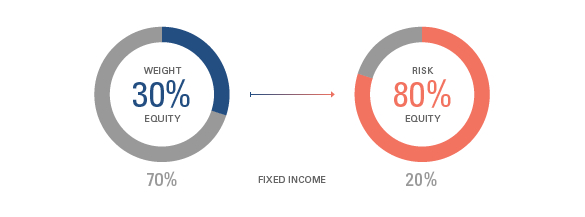
How can investors adapt? One potential answer would be to increase their bond allocations. But the effect on risk of this approach historically has been limited. Over the same period, a decision to reverse the allocations – 30%to stocks, 70% to bonds, a “30/70 portfolio” – still left a majority of portfolio risk in equities (80%).

EXHIBIT 2: EXAMINING THE RISK OF A HYPOTHETICAL 30/70 EQUITY AND FIXED INCOME PORTFOLIO

Diversifiers Risk Allocation chart 2

Source: GSAM, Bloomberg. For illustrative purposes only. The 76% equity risk measurement is calculated as a proportion of total portfolio volatility, as measured by the aggregate monthly price moves of the asset classes listed in Exhibit 2, using Bloomberg data. As of Dec. 31, 2014, covering the period 2001-2014, the period of earliest common inception of the indices. The 30/70 Capital Allocation is defined as 70% US Aggregate Fixed Income, 10% US Large Cap Growth, 10% US Large Cap Value, 5% US Small Cap, 5% International The returns represent past performance. Past performance does not guarantee future results, which may vary. Current performance may be lower or higher than the performance quoted. The performance results are based on historical performance of the indices used. The result will vary based on market conditions and your allocation.


If fixed income historically has succeeded in diversifying only some proportion of portfolio risk, we believe investors may want to understand the role that other asset classes potentially can play. In our view, diversifiers such as Emerging Markets Equity, International ex US Developed Small Cap, Real Estate Investment Trusts, Emerging Market Debt, High Yield, and Bank Loans have the potential not only to diversify portfolio risks, but to drive investment returns, too – provided the allocations are determined in a risk-conscious manner.

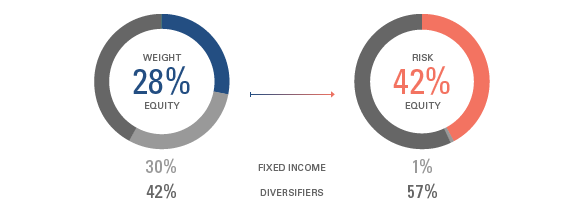
If we split the 70% equity allocation in the 70/30 portfolio to 42% diversifiers and 28% core equities, we find that, historically, this new, more diversified portfolio derived 57% of its risk from the diversifier asset classes (using the same definition of risk as above – the annualized volatility of historical returns), 42% of its risk from equities, and 1% from fixed income, measuring in the same way as above. We attribute this difference to the greater diversity of sources of return and risk in the portfolio which included diversifier asset classes – an approach which scaled back the dominant role that core equities play in many investment portfolios.

EXHIBIT 3: EXAMINING THE RISK OF A PORTFOLIO WHICH INCLUDES DIVERSIFIERS

Diversifiers Risk Allocation chart 3

Source: GSAM, Bloomberg, reflects SAS Portfolio Strategy model portfolios. The 42% equity risk, 1% fixed income risk, and 57% diversifiers risk are calculated as a proportion of total portfolio volatility, as measured by the aggregate monthly price moves of the asset classes listed in Exhibit 3, using Bloomberg data. For illustrative purposes only. As of Dec. 31, 2014, covering the period 2001-2014. The 30/42/28 Capital Allocation is defined as 30% US Aggregate Fixed Income, 42% Diversifiers (Diversifiers are defined as: 10% Emerging Debt USD, 22% Global High Yield, 9% Bank Loans, 24% Emerging Market Equity, 18% Global Ex US Developed Small Cap, 5% Global ex US Public Real Estate, 6% US Public Real Estate, and 7% Commodities), 5.2% US Large Cap Growth, 5.2% US Large Cap Value, 2.4% US Mid Cap Growth, 2.2% US Mid Cap Value, 4.2% US Small Cap, 8.9% International. See index definitions below for indices used to represent each asset class.  The returns represent past performance. Past performance does not guarantee future results, which may vary. Current performance may be lower or higher than the performance quoted. The performance results are based on historical performance of the indices used. The result will vary based on market conditions and your allocation. Please see asset class definitions and risks in end disclosures.


Stay posted on the latest market developments and key themes for your portfolios and practices.
Get Connected

Related Posts

June 30, 2015 | GSAM Connect
On Being Diversified, Strategic, and Careful

We believe long-term allocation choices should be based on more than the recent past - and history tells us that investors who limit themselves this way many miss out on potentially attractive investment opportunities.