

Menu Our services in the selected location:
  • No services available for your region.
Select Location:
Remember my selection
Your browser is out of date.
GSAM Connect 
|
June 30, 2015

GSAM Connect | June 30, 2015

Interest Rates and Your Portfolio: Lessons from History

The subject of rising interest rates is back in the headlines. How should investors think about the potential impact of rising rates on their portfolios? Here are some of the lessons we draw from the past.

  • Shifts in rate regimes historically have moved with speed – surprising both the market and the Federal Reserve
  • Historically, global stocks have often risen both before and after policy rate-hike cycles
  • In the US, stocks have frequently dipped as investors assess the change in environment, only to reverse course in the coming months, creating potential buying opportunities
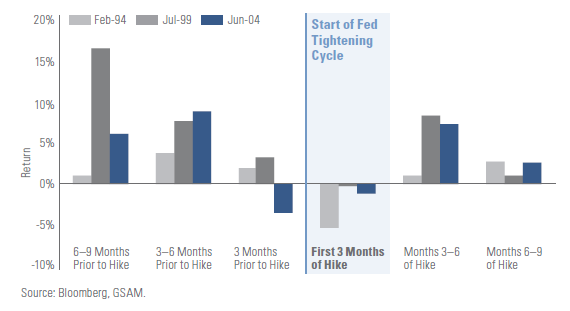
EQUITIES HISTORICALLY HAVE ADVANCED BEFORE AND AFTER RATE INCREASES

Equities Historically Have Advanced

Chart is based on monthly average S&P 500 returns over a three-month period. For a given rate hike cycle, the start of the hike is defined as the average S&P 500 index price of the previous month.

The element of surprise: Rates historically have often gained faster than expected

History affords several examples of both investors and policymakers failing to anticipate the speed of change once a new rate cycle has begun.

The 1994 rise in the Federal funds target rate overshot the Fed’s projections by more than two percentage points within four months of the initial rate increase. Subsequent periods of increased Federal funds rates in 1999 and 2004 also saw early projections outpaced, albeit by smaller margins.1

As these cases show, markets historically have shown themselves capable of outflanking the prevailing opinion of investors.

Global equities historically have advanced before and after rate increases

While there is no perfect historical precedent for today’s market, we do know that stocks have advanced in the majority of recent historical examples of rising interest rates. Specifically, in the last 32 policy-rate hike cycles globally, local equity markets gained a median 12% in the 12 months leading up to the start of the new rate cycle.2

A similar pattern emerges when examining what happens after the onset of a new rate regime. The median equity market rose 10% in the year following the initial hike in the same sample of 32 different instances.

In the US, a history of dips followed by gains

The trend over one and two-year periods in the US recently has been similar. The S&P 500 gained an average 17% during the 12-month periods leading up to the prior three rising-rate regimes beginning in 1994, 1999 and 2004. Then, after the Fed raised rates, the S&P 500 in the above cases added another 6%, on average, in the subsequent year.3

We believe rising stocks and rising rates may simply be byproducts of the same broader trend: the rising pace of economic activity.

Should interest rates increase, don’t be shocked if US stocks experience a short-term dip. Such dips have historically been commonplace at the onset of rising-rate periods. Because these historical declines have been short-lived, however, “rate scare” selloffs have frequently turned into attractive buying opportunities.

Stay posted on the latest market developments and key themes for your portfolios and practices.
Get Connected

Related Posts

June 30, 2015 | GSAM Connect
On Being Diversified, Strategic, and Careful

We believe long-term allocation choices should be based on more than the recent past - and history tells us that investors who limit themselves this way many miss out on potentially attractive investment opportunities.