We believe currency hedging may make sense when:
1. Investors seek lower volatility. Hedging, in our view, potentially may help diversify the drivers of return in an equity allocation. That’s because hedging seeks to replace a local currency exposure with foreign currency (and the foreign currency’s price moves may have lower correlation[1] with the equity allocation over time). For this reason, we view lower volatility as one potential goal of a currency hedged approach.
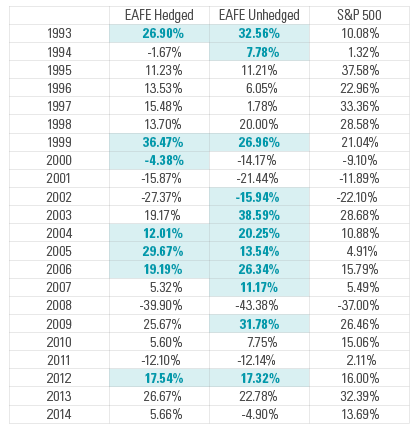
2. Investors have high-conviction currency views and/or seek tactical positions. The US Dollar has risen against major foreign currencies since mid-2014.[2] Investors with a strong belief that the US Dollar can continue rising may consider hedging international equity allocations, since hedging replaces foreign currencies with the US Dollar. In the short run, as Exhibit I shows, currency impacts can vary widely – and investors should be prepared for returns which may differ substantially from unhedged market indexes.
3. Investors are under-exposed to US Dollar-denominated assets. Hedging the Euro from a European equity investment (to take one example) and substituting in a US Dollar exposure would increase an investor’s overall US Dollar exposure. For this reason, currency hedging may be appropriate for investors who have identified a need for more US Dollar-denominated assets.
Now let’s examine cases in which we believe currency hedging may make less sense:
1. Investors have a long-term horizon. In the long run, the returns of the hedged and unhedged equity investments have been similar. For instance, the MSCI EAFE Index, a benchmark of developed-world equities, has returned an annualized 6.10% since the beginning of 1993 (the Index’s inception), versus 6.28% for the MSCI EAFE100% Hedged to USD Index. A comparable pattern has taken place in the MSCI Europe Index over the same time frame (7.97% unhedged annualized Index returns, versus 7.61% hedged). These results are consistent with our view that currencies’ long-term expected returns, when compared to one another, may approach zero, after accounting for differences in local interest rates.
2. Investors are overweight US Dollar-denominated assets. We believe many investors exhibit a “home country bias” in their investments. If a US investor’s portfolio consists of dollar-denominated assets, leaving the Euro, Yen or other foreign currency exposure within an international equity investment potentially may add to portfolio diversification.
3. Investors seek to maximize the diversification benefits of non-US equities. In our view, the decision to diversify a portfolio with international equities may be more important than the decision to hedge or not to hedge. For instance, as Exhibit 1 shows, both the hedged and unhedged EAFE Indexes generally outperformed (and underperformed) the S&P 500 Index in the same years as one another. In the seven years that the MSCI EAFE 100% Hedged to USD Index outperformed the S&P 500, the unhedged version of the index outperformed the S&P 500 six times. In terms of correlation to US stocks, the hedged index has had a 0.81 correlation to the S&P 500 since 1993, while the unhedged index has had a 0.80 correlation. As those figures suggest, both approaches historically have delivered similar diversification benefits.
In sum, we believe the decision to hedge or not to hedge can present a number of considerations for investors – and that hedging need not be an either/or proposition. Investors may, for instance, choose to split an allocation between hedged and unhedged exposures.
Historically, a blend of hedged and unhedged exposures has outperformed either index alone. Since 1993, a 50-50 blend of the hedged and unhedged MSCI EAFE Indexes returned an annualized 6.43% (versus 6.28% for the hedged index, versus 6.10% for the unhedged). (The performance results are based on historical performance of the indices used. The result will vary based on market conditions and your allocation.)
Diversification does not protect an investor from market risk and does not ensure a profit.