

Policy-related market divergence can also be examined by quantitatively analyzing price trends, writes James Park, senior portfolio manager for the Macro Alpha team within GSAM’s Quantitative Investment Strategies platform.
In The Spotlight
Stay on top of the latest market developments, key themes, and investment ideas affecting your portfolio and practices.
Explore how we can help you
Talk to UsNote: Separate multiple email address with a comma or semicolon.
Your Name:
Your Email Address:
Policy-related market divergence can also be examined by quantitatively analyzing price trends, writes James Park, senior portfolio manager for the Macro Alpha team within GSAM’s Quantitative Investment Strategies platform.
Given the recent unconventional moves made by the ECB and BoJ, many sovereign debt markets have entered uncharted territory. At the same time, US Fed has been gearing up to raise its benchmark rate in response to stronger US economy. During this period of market speculation on the future of central bank policy and its scale of impact on economies and financial markets, we are observing some key turning points and divergence in many macro assets. Using quantitative methods, we have observed that since the beginning of 2016, many asset classes are exhibiting increased price divergence.
Below we focus on two notable episodes of price trend divergence within two major asset classes.
As markets moved away from the USD-driven environment in 2014 and further stabilized after the Chinese currency devaluation in August 2015, we now observe more pronounced diverging trends in global currencies. These trends are partly caused by differences in central bank moves among developed and emerging economies, and partly driven by other macroeconomic shocks (e.g. Brexit).
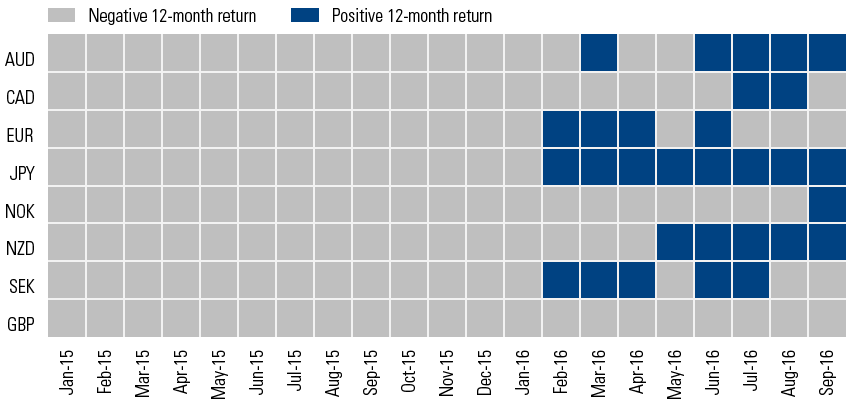
Exhibit 1 below illustrates that starting from 1Q 2016, the performance of global currencies versus the US dollar has become more dispersed.
Source: GSAM. As of September 2016.
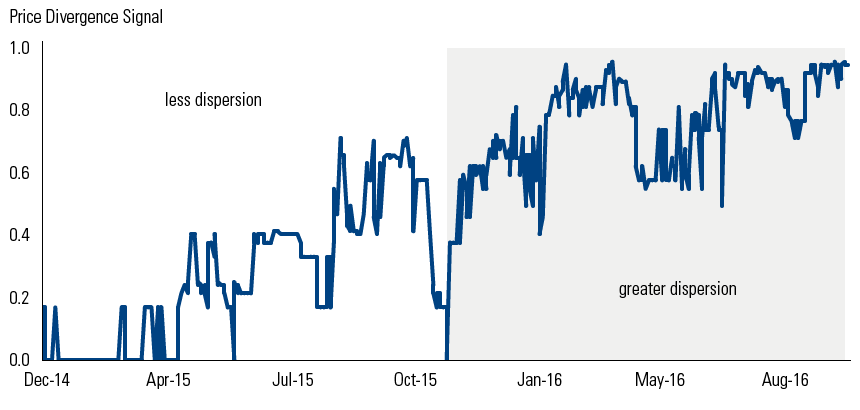
Exhibit 2 shows the divergence signal in global currencies, measured using simple trend signals defined over multiple return horizons.1 This measure again confirms the diverging trend in this market and highlights the lack of US dollar dominance previously observed in this asset class.
Source: GSAM. As of September 2016.
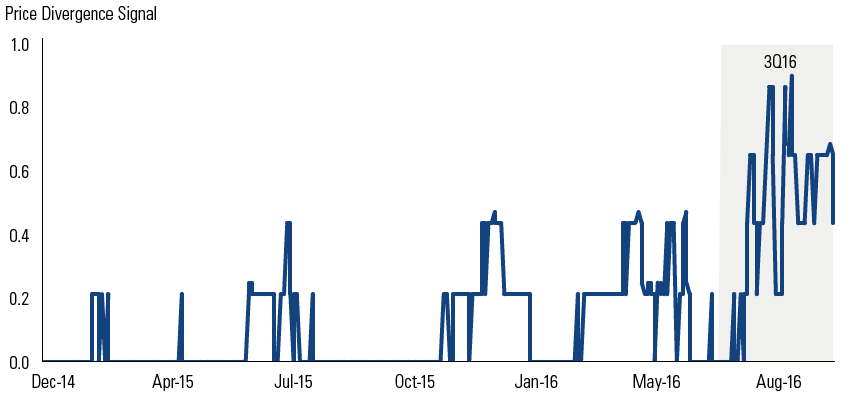
Starting in 2016, we have also seen divergence in the short-term interest rates market, which has previously moved largely in unison (divergence signal of less than 0.5). This dichotomy grew in 3Q 2016, as the expectation of a US rate hike intensified. Interestingly, this divergence is not happening in the longer tenor points. This suggests many investors may be skeptical about the prospect of a sustained rise in US interest rates in the near term.
Source: GSAM. As of September 2016.
Some of the divergence within asset classes may offer more nuanced and potentially diversifying investment opportunities for trend-following investors.
In fixed income, for example, short-term US Treasuries look bearish while US 10-year Treasury notes appear attractive from a trend perspective. This suggests a yield curve flattening trade.
Despite broadly positive performance of risk-on assets, we also see some strong positive trends in risk-off assets – some of these include Japanese yen and precious metals. These types of risk-offsetting trend trades may be especially appealing to investors who utilize trend following approaches for its diversification benefits.