Neill Nuttall, Co-Chief Investment Officer for GSAM’s multi-asset group, Global Portfolio Solutions (GPS), discusses the case for maintaining exposure to risk assets while global growth remains in the expansion phase of the cycle.
In The Spotlight
Stay on top of the latest market developments, key themes, and investment ideas affecting your portfolio and practices.
Explore how we can help you
Talk to UsNote: Separate multiple email address with a comma or semicolon.
Your Name:
Your Email Address:
Neill Nuttall, Co-Chief Investment Officer for GSAM’s multi-asset group, Global Portfolio Solutions (GPS), discusses the case for maintaining exposure to risk assets while global growth remains in the expansion phase of the cycle.
Do you think secular stagnation is taking over from the economic cycle as a key driver of markets?
No. We believe the current environment is best understood as a prolonged cyclical recovery from an unusually large economic shock. Despite all the talk about secular stagnation our analytical work suggests that asset performance can be explained well by cyclical dynamics. In particular we believe that current low bond yields are anchored by monetary policy which is likely to shift as US growth continues to bring down unemployment and increase inflation. Our view contrasts with the secular stagnation view that we have seen a structural shift to a low nominal growth environment where interest rates will stay very low for a very long time.
If secular stagnation is less of a concern, what other risks are you focused on?
We do worry that a shift in market perception of monetary policy could lead to a rapid shift higher in global bond yields causing volatility across assets. Right now, there seems to be a very high burden of expectation on policy makers, both monetary and fiscal, to stay behind the curve and keep conditions very easy. We saw the ECB recently disappoint such expectations and we think the change in focus of the Bank of Japan could also lead to disappointments.
On the fiscal side, we do not think the US political framework will permit sizeable fiscal easing, nor for that matter do we believe that the prevailing macro conditions there warrant such easy policy. Further disappointments of actual policy relative to elevated expectations are a likely catalyst for a sell-off at some point in coming months.
Beyond that, there appears to be a gap between recent economic data surprising to the downside while markets have been holding up, and we have trimmed equity risk tactically, to prepare for a potential short term drawdown. Later this year, we believe that we shall see some rise in market volatility around the US election, which is only now starting to get priced in markets. Finally, as the impetus from fiscal stimulus fades in China, the risks are to the downside in the short term there too.

If we are in a prolonged cyclical recovery, how are you managing client portfolios to navigate that?
We believe we can add significant value by adjusting the risk posture of portfolios to account for where we are in the economic cycle. In particular, we are aiming to avoid potential downsides: winning by not losing as it were. Beyond ascertaining where we think we are in the cycle, we look at the valuation of assets relative to economic conditions, we try and answer the question "why might this cycle be different" and we also look for specific latent risks in markets (for example credit growth in China) when we make these adjustments to the risk posture.
Source: GSAM Global Portfolio Solutions (GPS). As of September 2016. *Note that this does not account for liability-driven investment.
How are you positioned in your portfolios?
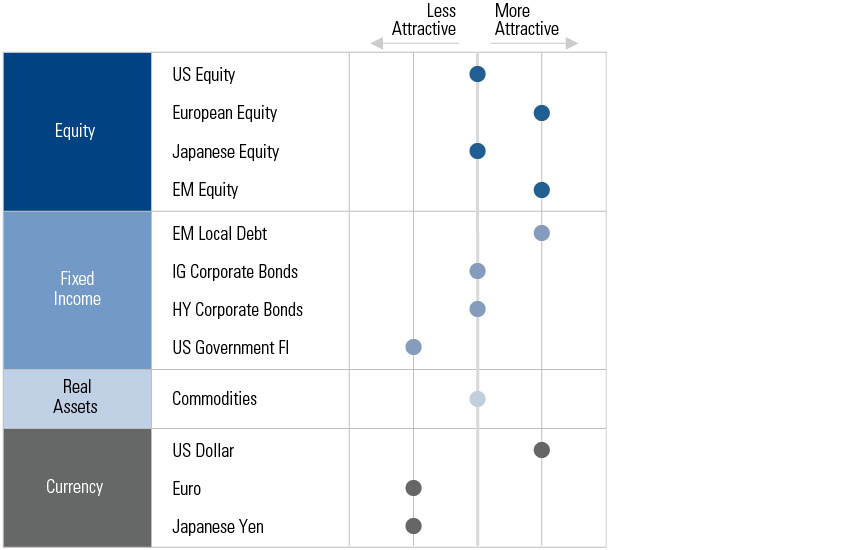
We believe we are still in an expansionary phase of the cycle and so remain overweight risk assets. That said, return potential is broadly more muted and therefore we are emphasizing a theme of dynamism in portfolios. While our positive growth outlook underpins our overweight to equities and some credit investments over the medium term, dynamism makes us focused on buying when the market dips and taking profit judiciously on fast rallies. We like EM over the medium term, though we have trimmed our tactical overweight recently after the rally. We think EM currencies are at attractive valuations and the economic outlook for the universe is reasonably strong. EM currencies and debt also offer attractive carry which is another theme we have been overweight for some time. Finally, we are underweight DM government rates and also bond surrogate equities such as utilities.
So it would be fair to say equities over credit over rates?
Yes, absolutely. And EM over DM for now.