


Menu Our services in the selected location:
  • No services available for your region.
Select Location:
Remember my selection
Your browser is out of date.
GSAM Connect 
|
July 31, 2015

GSAM Connect | July 31, 2015

Chinese Stocks: Right for Your Portfolio?

We believe the recent stock-market turbulence in China begs an important question: What role should Chinese equities play in investors’ portfolios?

One useful starting point is to recognize that the searing gains in Chinese stocks over the past 12 months appear to be out of sync with the country’s economic growth and corporate fundamentals (See chart). We believe government policy has been a factor in fostering the market rallies which preceded the recent turbulence.

China’s market rally accelerated in the second half of 2014 with the implementation of looser central bank policy, in which the People’s Bank of China (PBoC) cut interest rates four times and trimmed the required reserve ratio for banks repeatedly in the subsequent months. Although the surge in equities initially may have reflected domestic optimism in an economic revival, this optimism was levered with rapidly rising margin financing, wherein investors bought securities with borrowed money.
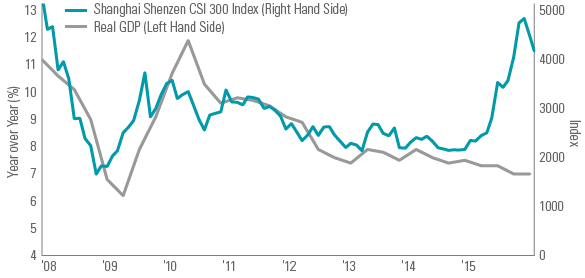

China's disconnect in growth and equities

Chinese Stocks

Source: Bloomberg, as of July 24, 2015


Officials embraced the market rally, which was a boon for state-owned enterprises (SOEs) and for the policy objective of free market reforms. However, as the stock market went into freefall—triggering stock-trading suspensions peaking at almost half of the market on July 9—Chinese policymakers lost little time intervening with intensity and urgency. The interventions have included guiding institutions and brokers to buy stocks and exchange-traded funds (ETFs), urging SOEs not to sell shares, and relaxing some margin financing rules.

We believe Chinese equities can be a critical part of a balanced emerging markets equity allocation, given China’s prominence in the global economy. We further believe that the selloffs have helped clear out some of the riskiest participants, in our view, and some of the excess in stock valuations. However, they also highlight the considerable volatility of investing in Chinese markets – driven in no small part by the country’s policy uncertainty, as officials balance the risks and rewards of market liberalization.

In the near term, we expect continued stock price volatility, due to: 1) evolving government policy, 2) the aftereffects of the just-described boom in margin financing, 3) the potential for contagion to “offshore” Chinese equities and 4) stocks moving in and out of trading suspensions.

The picture is not entirely grim, however. Just as the past year’s market rally caused stock valuations to detach from company and industry fundamentals, the recent market correction may also create more reasonable valuations for select stocks across a variety of sectors.

The Renminbi as a Reserve Currency?

What does all this market turbulence mean for the Chinese currency, the renminbi? We think economic fundamentals may justify weaker levels for the renminbi, but policy issues may make the outlook especially uncertain. The International Monetary Fund (IMF) is preparing a formal review of the renminbi’s eligibility for inclusion in a mechanism known as the Special Drawing Rights (SDR) basket, which would confirm its status as a global reserve currency. To better meet the IMF’s criteria, the PBoC is likely to widen the range in which the renminbi may fluctuate around the dollar again this year (a move often described as widening the “trading band”), but China may also wish to curb any volatility that could impact the IMF’s decision. The IMF has indicated that the renminbi is on a path for inclusion, but the outcome of its fall review is still in question.

Stay posted on the latest market developments and key themes for your portfolios and practices.
Get Connected

Related Posts

July 10, 2015 | GSAM Connect
Putting China in Perspective

Chinese equities have suffered a significant correction since mid-June amid sharp daily gyrations. While the government has taken a heavy-handed approach in an attempt to stem the fall, we believe investors should view the selloff in broader context.

July 29, 2015 | GSAM Connect
Why the Economic Recovery May Still Have Legs

A first-quarter economic slowdown. An expansion which began in June 2009 and turned six years old last month. Ahead of Thursday's GDP report, investors may reasonably ask: is the recovery getting long in the tooth?