



In our view, global markets’ rocky start to 2016 illustrates the challenges – but also the importance – of making sound long-term investment decisions. As the headlines focus on falling oil prices or turbulence in China, we would note that investors seeking to take action in a fast-changing market climate may have difficulty knowing whether the portfolio changes they are considering are proactive or reactive, constructive or counterproductive. Here is what we emphasize for investors as they make decisions about positioning their portfolios for the future.
1. Selloffs are a normal investing experience. The equity market correction which began in mid-2015 may feel abnormal, but the truth is quite the opposite. Declines of 10% or more, the standard definition of a market correction, have occurred with regularity in major equity benchmarks. For instance, in the U.S., the S&P 500 has dropped by at least 10% on average more than once a year over the last quarter century.1 The difference for investors today may be that, until late 2015, we had not experienced a 10% drop in four years. In our view, investors should design their portfolios with the likelihood of market volatility in mind, seeking to build portfolios with the potential to withstand the ups and downs.
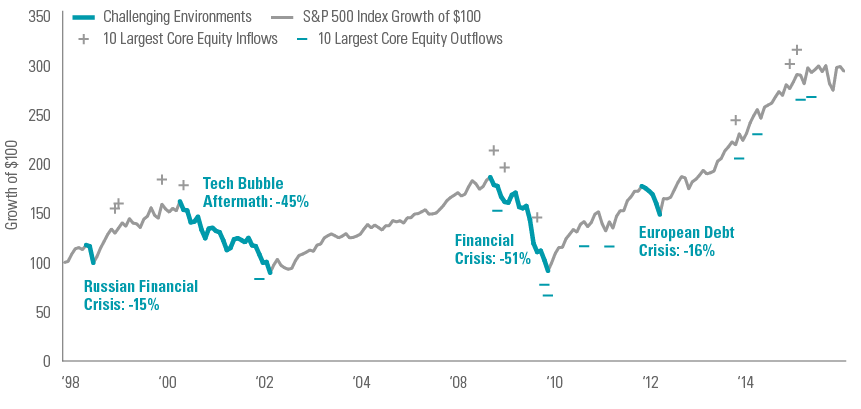
2. Attempting to “time” the market may result in a poor investment experience. Trying to predict market moves is no path to financial security. Yet historical fund flows show the average investor typically has underperformed the very same funds in which he or she has invested, due to errant timing decisions.2 Over time, this “investor” return can result in a drag on performance. Exhibit 1, portraying the phenomenon in the aggregate, shows that (1) the ten largest monthly US equity fund inflows (represented by a “+”) have often occurred near short-term peaks in the S&P 500, and (2) , the ten corresponding largest outflows (“-“) have clustered near short-term S&P 500 bottoms. The lesson we draw: Investors would have been better off avoiding market timing and instead take a long-term mindset to investing.